2019–2025: A Continuing Development Journey
In June 2019 I shifted gears, stepped into a new stack reality, and began what became a multi‑year transformation effort—moving teams from legacy patterns to modern, observable, automated, component‑driven engineering. After documenting the first five years, this post extends the story through 2024 and into 2025, where frontend standardisation, .NET Aspire, telemetry, and AI‑integrated developer workflows have become core pillars.
2019 – Foundation & Transition
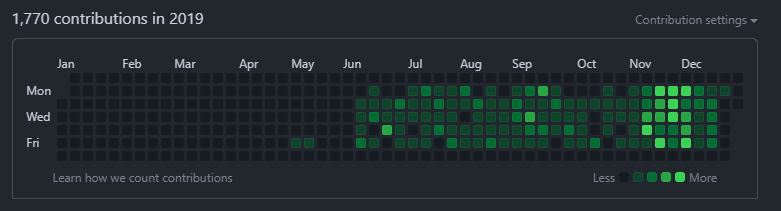
Early tactical objective: extract the team from heavy WebForms + jQuery dependence while still delivering features. Introduced incremental Vue islands inside ASPX pages to build confidence and shrink the gap to a modern SPA mindset. Began sowing seeds for automation and cleaner deployment paths.
2020 – Resilience, Recovery & Tooling Seeds
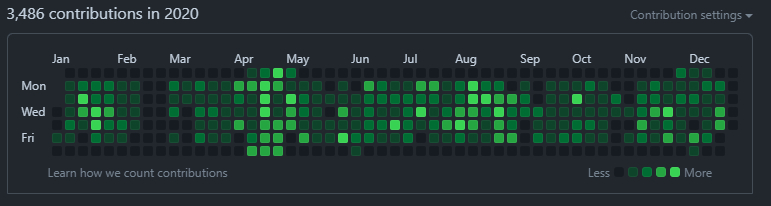
A health interruption briefly slowed momentum, but the interruption forced prioritisation. Contributed to external JavaScript object export tooling that later became a multiplier internally. Summer output drove multiple launches; began deeper alignment with Microsoft/Azure ecosystems (Teams integration, internal process migration). Early automation experiments started shaping future velocity.
2021 – Scaling Automation & Structural Shifts
Focus moved to migrating larger functional areas. Breaks were used deliberately to avoid burnout while ramping up automation around build, release, and environment provisioning. Team and office reshuffles required adaptive knowledge transfer. The groundwork for later telemetry and standard infra patterns started forming conceptually.
2022 – Managing Legacy While Enabling Learning
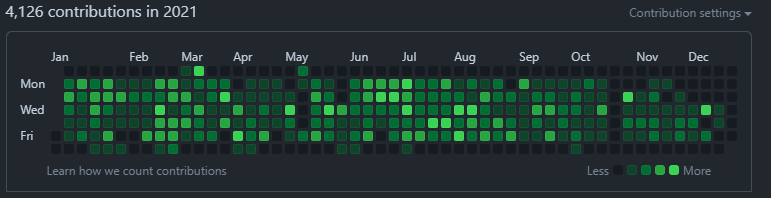
Energy redirected into stabilising and extending legacy systems under customer pressure. This meant tactical delivery over pure refactor freedom. Weekend bursts helped unblock longer-term improvements. Drew clearer boundaries by late Q3/Q4 to make space for platform shifts. Mentorship and internal teaching dominated more of the time budget.
2023 – AI Acceleration, Infra Automation & Operational Maturity
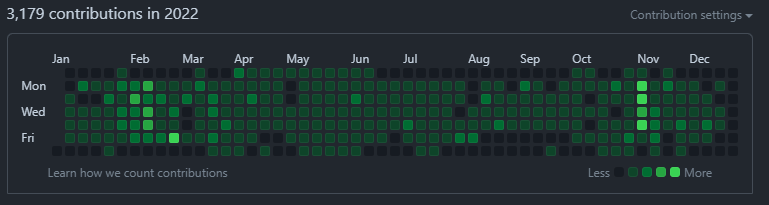
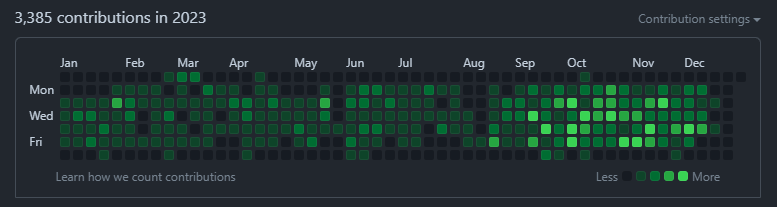
The plan set in late 2022 pivoted: more enablement, more scripting, more operational uplift. Heavy investment in PowerShell automation for release pipelines, provisioning, and environment repeatability. AI tooling started augmenting rote scripting and documentation generation. Late‑year contribution density reflects prior automation compounding, not raw hours. Operations + build server orchestration + feature throughput coexisted effectively.
2024 – Frontend Standardisation & Infrastructure Modernisation
A mission reset: unblock infra debt that had constrained 2023 velocity. Parallel tracks emerged:
- Frontend: Consolidating patterns in Vue (composition API adoption, component library curation, early theming alignment, experimentation with Ionic where mobile parity mattered). Evaluated design system direction (Material variants, internal tokens, accessibility baseline improvements).
- Backend: Expansion into .NET 9 previews and early Aspire orchestration concepts—defining service boundaries, wiring structured logging, health endpoints, and exploring OpenTelemetry pipelines.
- Developer Experience: Template repos, consistent lint/test run scripts, commit message conventions, and environment spin‑up simplification.
- Training: Internal sessions on EF Core patterns (migrations discipline, performance diagnostics, SQL + telemetry interplay) and telemetry value (correlating frontend events to backend traces).
Two views of contributions: an in‑year snapshot and a full‑year consolidated chart.
Existing partial-year snapshot: 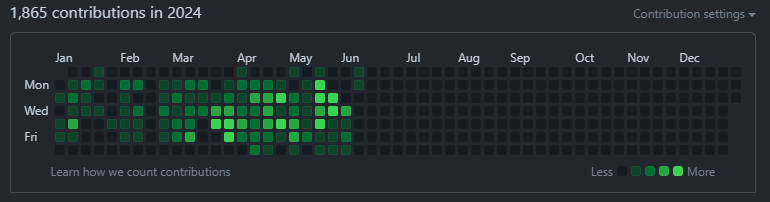
Full‑year view: 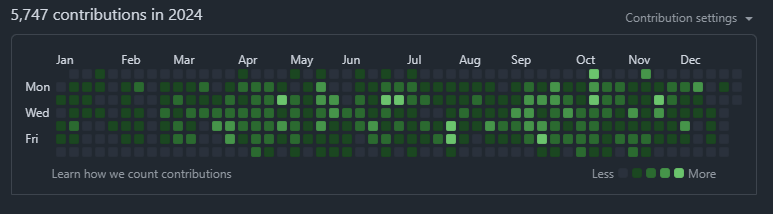
2025 – Convergence: Aspire, Telemetry, Design Systems & AI‑Integrated Flow
This year marks consolidation rather than pure expansion:
- .NET 10 Readiness: Hardening service boundaries, adopting minimal API ergonomics where appropriate, and refining exception + trace correlation.
- Aspire-Based Projects: Standardising local orchestration (multi-service + backing store + message broker) with opinionated defaults: structured logging, OpenTelemetry exporters, metrics surfacing, health checks, and ephemeral test data strategies.
- Telemetry Maturity: Moving from “logs exist” to actionable signals—dashboards for latency percentiles, build → deploy → incident correlation, and proactive anomaly detection.
- Frontend Stack Evolution: Vue architecture guidelines (state isolation, clear composition boundaries, SSR readiness where needed) plus Ionic channels for mobile-adjacent experiences. Component tokens mapped towards design system aspirations (Material 3 explorations, dark/light adaptive surfaces, semantic spacing and elevation primitives).
- Entity Framework Training: Advanced query shaping, batching strategies, concurrency patterns, and balancing raw SQL vs LINQ readability.
- AI in Daily Dev Flow: Code review augmentation, test case suggestion, release note drafting, repetitive infra script generation, and architectural diff summaries for stakeholders.
- Security & Governance: Shift-left scanning integration, dependency health reporting, secrets hygiene reinforcement.
Full-year (to-date / rolling) contributions: 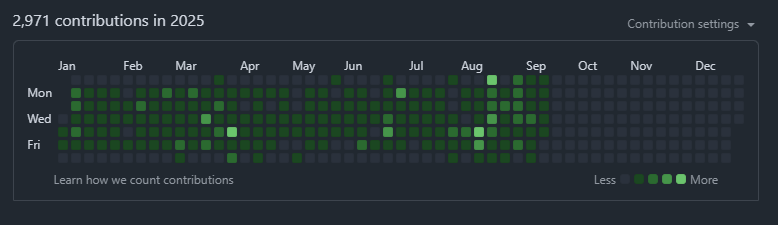
Technology & Practice Highlights (2019–2025)
- Migration Path: WebForms → MVC/API → Minimal APIs & service-oriented boundaries.
- Frontend Evolution: jQuery islands → Vue micro-integrations → Standardised Vue app shells → Ionic exploration for mobility.
- Observability: From ad-hoc logs → structured logging → metrics + traces → trace/event correlation via OpenTelemetry pipelines.
- Data Layer: Manual SQL + ORM basics → disciplined EF Core migrations, performance tuning, connection strategy reviews.
- Automation: Script fragments → cohesive PowerShell modules → templated pipelines → AI-assisted generation.
- Design & UX: Unstructured styling → component encapsulation → theme tokens → investigation into Material 3 & brand-aligned semantic layers.
- Developer Experience: Reduced on-boarding friction (scaffold scripts, consistent repo patterns, local orchestration via Aspire and containers).
- AI Augmentation: From ad-hoc experiments to repeatable accelerants (reviews, documentation, infra scaffolds, test suggestion loops).
Lessons Reinforced
- Incrementalism beats big-bang rewrites when legacy demand remains high.
- Automation compounding is invisible—until it isn’t. Later productivity spikes are earned years earlier.
- Telemetry without interpretation is noise; design the questions before instrumenting.
- Design systems require both tokens and cultural adoption; code is the easy part.
- AI amplifies strategy, not the absence of one. Clear architecture + conventions unlock meaningful augmentation.
Looking Forward (Beyond 2025)
- Formalising a lightweight internal design system built on tokens that compile to multiple target frameworks.
- Broader adoption of Aspire-style local environment parity for new services.
- Expanding test observability (flaky detection, coverage heatmaps tied to service ownership).
- Progressive enhancement of mobile + desktop convergence via shared component primitives.
- Continuous refinement of AI-assisted workflows with guardrails (privacy, security, reproducibility).
The journey is still more than contribution graphs—they’re just a shadow of design discussions, code reviews, release orchestration, and mentoring that shaped the real output. The next phase focuses on measurable developer experience, resilient architectures, and sustainable velocity.
Six years in, the throughline remains: reduce cognitive load, increase clarity, and leave systems easier to extend than they were found.
If you’ve followed earlier retrospectives, thanks for reading the extended arc. Onward.